

Have you ever seen the word SMS on your phone and wondered what it actually means?
Maybe someone mentioned SMS in a conversation, or you noticed it while sending a message and felt unsure whether it was different from a regular text.
You are not alone! SMS is one of the most common terms in mobile communication, but many people still wonder what the letters stand for and how they work.
Understanding SMS meaning in texting helps you recognize the difference between traditional text messages, internet messaging apps, and other forms of digital communication.
Let’s explore its meaning, uses, examples, and common questions.
Quick Answer:
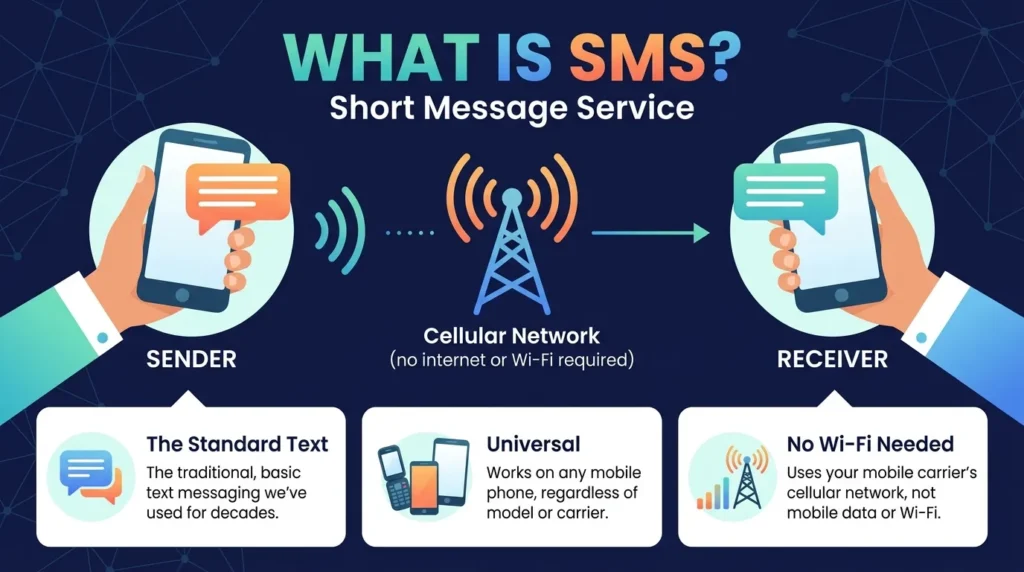
SMS means Short Message Service. It is a standard way to send text messages between mobile phones using a cellular network.
What Does SMS Mean in Text?
SMS stands for Short Message Service. It is the technology used to send traditional text messages from one mobile phone number to another through a mobile carrier. Unlike messages sent through internet-based apps, standard SMS does not require the sender and receiver to use the same messaging application.
For example, when you open your phone’s messaging app and send a simple text to someone’s phone number, that message may be sent as an SMS.
SMS is commonly used for everyday communication, including greetings, reminders, appointment updates, and verification codes. It has been an important part of mobile communication for decades because it allows people to exchange short written messages quickly.
Here are some common situations where SMS is used:
- Personal messages: Sending a quick hello or checking in with a friend.
- Business notifications: Receiving delivery updates, appointment reminders, or service alerts.
- Verification codes: Getting one-time passwords to confirm your identity.
- Emergency updates: Receiving important alerts from organizations or service providers.
- Mobile communication: Sending texts without needing an internet-based messaging app.
Although SMS is associated with short messages, modern phones and carriers can sometimes split longer messages into multiple SMS segments or use other messaging technologies.
Example:
A: did you get my message?
B: yes, i received your sms 😊
In this example, SMS refers to a traditional text message sent to a mobile phone.
In short: SMS = Short Message Service = a technology for sending traditional text messages between mobile phones.
Where Is SMS Commonly Used?
SMS is used worldwide for personal communication and automated notifications. You may encounter the term in your phone settings, messaging apps, online accounts, and business communications.
Here are some common places where SMS appears:
- 📱 Text messaging: Sending ordinary messages between mobile phone numbers.
- 💬 Phone messaging apps: Using the default messaging app on Android or an iPhone when the message is sent as SMS.
- 🔐 Account verification: Receiving security codes to confirm a login or account registration.
- 🛍️ Online shopping: Getting order confirmations, shipping updates, and delivery notifications.
- 🏦 Banking services: Receiving transaction alerts or verification messages, depending on the bank.
- 📅 Appointments: Receiving reminders from doctors, salons, or other service providers.
- 💼 Business communication: Sending customer updates, confirmations, and service notifications.
- 📢 Public alerts: Receiving certain emergency or community notifications through supported alert systems.
SMS is not slang in the same way as LOL or BRB.
Apps such as WhatsApp and Instagram generally send messages over the internet. Depending on your device, settings, and carrier, your phone’s messaging app may send messages using SMS, MMS, or newer technologies such as RCS.
Examples of SMS in Conversation
Here are seven realistic examples showing how people use SMS in everyday communication.
1. Talking About a Text Message
A: did you send me an sms?
B: yes, check your messages 📱
Meaning: They are discussing a traditional text message sent to a phone.
2. Receiving a Verification Code
A: how do i verify my account?
B: they will send you an sms with a code 🔐
Meaning: The person is explaining how a verification message arrives on a phone.
3. Discussing Phone Problems
A: my messages aren’t going through
B: try checking your cellular signal first 📶
Meaning: They are discussing a possible problem with traditional mobile messaging.
4. Talking About a Delivery
A: how will i know when my package arrives?
B: the company will send you an sms update 📦
Meaning: SMS is being used to describe an automated delivery notification.
5. Asking About Message Charges
A: will sending this text cost money?
B: it depends on your mobile plan and carrier
Meaning: They are discussing the potential cost of sending a traditional text message.
6. Comparing SMS With WhatsApp
A: why didn’t you message me on whatsapp?
B: my internet was down, so i sent an sms instead 😅
Meaning: The person used traditional texting when an internet-based app was unavailable.
7. Discussing an Appointment Reminder
A: how did the clinic remind you about your appointment?
B: they sent me an sms yesterday 📅
Meaning: The clinic used a text message to share appointment information.
These examples show that SMS usually refers to a messaging service rather than an emotion, reaction, or abbreviation used for flirting.
When to Use and When Not to Use SMS
SMS is appropriate in many everyday situations, but choosing the right wording depends on your audience and the purpose of your message.
✅ When to Use SMS
- When discussing text messages: Use SMS when you specifically mean traditional mobile text messaging.
- When explaining phone features: It is useful when talking about messaging settings or mobile services.
- When discussing verification: Use SMS when explaining how a security code arrives on a phone.
- When talking about business notifications: It clearly describes text-based alerts and reminders.
- When comparing messaging services: Use SMS to distinguish traditional texts from internet-based messaging.
- When writing technical information: SMS is the standard term used in mobile communication.
❌ When Not to Use SMS
- When you simply want to greet someone: Say Hi or Hey instead of using a technical term.
- When referring specifically to WhatsApp messages: WhatsApp messages generally use an internet connection rather than SMS.
- When describing photos or multimedia in traditional messaging: MMS may be the relevant term for messages containing supported media.
- When the audience may not understand abbreviations: Write Short Message Service the first time in a beginner-friendly explanation.
- When discussing every type of text message as if it were identical: Remember that SMS, MMS, RCS, and internet messaging have different technical features.
SMS in Different Contexts
| Context | Example Phrase | Why It Works |
|---|---|---|
| Friend chat | i sent you an sms 😊 | Casual and understandable |
| Work chat | The customer received an SMS notification. | Clear and professional |
| Business email | We will send an SMS confirmation shortly. | Appropriate for customer communication |
| Technical guide | SMS stands for Short Message Service. | Accurate and informative |
| App support | Check whether your phone can receive SMS messages. | Direct and practical |
Unlike many texting abbreviations, SMS is perfectly acceptable in formal and professional communication. It is a recognized technical term, so there is generally no need to avoid it in business writing.
Similar Slang Words or Alternatives
| Term | Meaning | When to Use |
|---|---|---|
| MMS | Multimedia Messaging Service | Traditional messages containing supported photos, videos, or other media |
| RCS | Rich Communication Services | Modern carrier-based messaging with supported enhanced features |
| DM | Direct Message | Private messages on social media platforms |
| PM | Private Message | Private communication in online communities |
| IM | Instant Messaging | Real-time messaging through internet-based services |
| Text | A written message sent electronically | Everyday conversations about messaging |
SMS vs. DM: SMS generally uses a mobile phone number and cellular messaging service, while a DM is a private message sent through a platform such as Instagram.
SMS vs. IM: Instant messaging generally refers to messages exchanged through internet-based services, while SMS uses the traditional mobile text messaging system.
Understanding these differences can help you troubleshoot messaging issues and choose the most suitable way to contact someone.
FAQs About SMS Meaning in Texting
1. What does SMS stand for in texting?
SMS stands for Short Message Service. It is the technology used to send traditional text messages between mobile phones.
2. Does SMS mean a regular text message?
Yes. In everyday conversation, SMS often refers to a regular text message sent through a mobile carrier.
3. Is SMS the same as texting?
Not exactly. Texting is the general activity of sending written messages, while SMS is one specific technology used for texting.
4. Does SMS require internet access?
Traditional SMS generally does not require mobile data or Wi-Fi. It uses a cellular network, although cellular service and carrier support are usually necessary.
5. Is SMS the same as WhatsApp?
No. WhatsApp messages generally use an internet connection, while SMS uses a mobile carrier’s traditional text messaging service.
6. What does SMS mean on an iPhone?
On an iPhone, SMS refers to traditional carrier text messages. The Messages app may also support iMessage, MMS, and RCS, depending on the device, settings, and carrier.
7. What does SMS mean on Android?
On Android, SMS refers to traditional text messages sent through a supported messaging app and mobile carrier.
8. Is SMS slang?
No. SMS is a technical abbreviation, not informal slang. It is commonly used in everyday and professional communication.
9. Can SMS messages contain pictures?
Traditional SMS is designed for text. Pictures and other multimedia are generally sent through MMS or another supported messaging technology.
10. Is SMS still used today?
Yes. SMS remains widely used for traditional text communication, notifications, and verification codes, although internet-based messaging services are also popular.
Understanding SMS meaning in texting helps you recognize how traditional mobile messages work and how they differ from modern messaging apps. Whether you are sending a quick text, receiving a verification code, or discussing phone settings, SMS is a useful term to know.